
Beam Capacity Charts – Click to View

*T: preceeds part no. for T-Bolt ex.: TF2
*G: precceds part no. for Interchangeable ex.: GF2
| 48" | F2 6356 04800SSS000 | 7991# 3.56″ x 48″L – 16 ga. |
| 60″ | F2 6356 06000SSS000 | 6544# 3.56″ x 60″L – 16 ga. |
| 72″ | F2 6356 07200SSS000 | 5573# 3.56″ x 72″L – 16 ga. |
| 96″ | F2 6250 09600SSS000 | 2126# 2.50″ x 96″L – 16 ga. |
| F2 6331 09600SSS000 | 3452# 3.31″ x 96″L – 16 ga. | |
| F2 6356 09600SSS000 | 3972# 3.56″ x 96″L – 16 ga. | |
| F2 6400 09600SSS000 | 5009# 4.00″ x 96″L – 16 ga. | |
| F2 6418 09600SSS000 | 5296# 4.18″ x 96″L – 16 ga. | |
| F2 6450 09600SSS000 | 5832# 4.50″ x 96″L – 16 ga. | |
| F2 6500 09600SSS000 | 6730# 5.00″ x 96″L – 16 ga. | |
| F2 6550 09600SSS000 | 7701# 5.50″ x 96″L – 16 ga. | |
| F2 6600 09600SSS000 | 8742# 6.00″ x 96″L – 16 ga. | |
| F2 4600 09600SSS000 | 9897# 6.00″ x 96″L – 14 ga. | |
| 108″ | F2 6356 10800SSS000 | 3206# 3.56″ x 108″L – 16 ga. |
| F2 6400 10800SSS000 | 4044# 4.00″ x 108″L – 16 ga. | |
| F2 6418 10800SSS000 | 4431# 4.18″ x 108″L – 16 ga. | |
| F2 6450 10800SSS000 | 5184# 4.50″ x 108″L – 16 ga. | |
| F2 6500 10800SSS000 | 6038# 5.00″ x 108″L – 16 ga. | |
| F2 4500 10800SSS000 | 6800# 5.00″ x 108″L – 14 ga. | |
| F2 4600 10800SSS000 | 8842# 6.00″ x 108″L – 14 ga. | |
| 120″ | ||
| F2 6356 12000SSS000 | 2649# 3.56″ x 120″L – 16 ga. | |
| F2 6400 12000SSS000 | 3329# 4.00″ x 120″L – 16 ga. | |
| F2 6418 12000SSS000 | 3643# 4.18″ x 120″L – 16 ga. | |
| F2 6450 12000SSS000 | 4254# 4.50″ x 120″L – 16 ga. | |
| F2 6500 12000SSS000 | 5353# 5.00″ x 120″L – 16 ga. | |
| F2 4500 12000SSS000 | 5943# 5.00″ x 120″L – 14 ga. | |
| F2 4600 12000SSS000 | 7997# 6.00″ x 120″L – 14 ga. | |
| 144″ | F2 6356 14400SSS000 | 1902# 3.56″ x 144″L – 16 ga. |
| F2 6400 14400SSS000 | 2377# 4.00″ x 144″L – 16 ga. | |
| F2 6418 14400SSS000 | 2596# 4.18″ x 144″L – 16 ga. | |
| F2 6450 14400SSS000 | 3021# 4.50″ x 144″L – 16 ga. | |
| F2 6500 14400SSS000 | 3785# 5.00″ x 144″L – 16 ga. | |
| F2 4500 14400SSS000 | 4192# 5.00″ x 144″L – 14 ga. | |
| F2 4600 14400SSS000 | 6369# 6.00″ x 144″L – 14 ga. | |
| F2 3600 14400SSS000 | 7653# 6.00″ x 144″L – 13 ga. | |
| F2 2600 14400SSS000 | 8979# 6.00″ x 144″L – 12 ga. |
All capacities are expressed in pounds per pair of beams. Only gravity loading and the RMI required impact have been considered.
All values are based on a uniformly distributed load (i.e. each beam carries 50% of the load) and assume proper installation and no beam damage.
The deflection limit for all beams is the length divided by 180.
Roll-formed beams that are longer than 150” require lateral ties.
Structural beams that are longer than 108″ can require lateral ties.Values in the table are for the beam bending only.
Please consult Springfield, Engineering for any shelf load over 10,000 lbs.
Capacities include 12.5% impact for two pallets side by side. For a three-pallet-wide shelf, the values should be multiplied by 0.95. For one pallet per shelf, the values should be multiplied by 0.90.
Capacity chart is based on current RMI specifications.
UNARCO rack designs conform to the latest Rack Manufacturers Institute (RMI) specifications and American Iron and Steel Institute (AISI) Cold Formed Steel Design Manual.
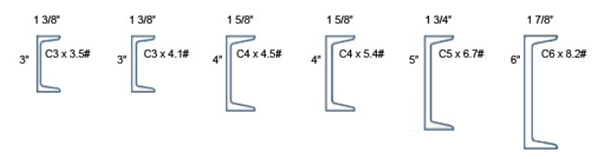
| Length | C3 x 3.5 | C3 x 4.1 | C4 x 4.5 | C4 x 5.4 | C5 x 6.7 | C6 x 8.2 | ||||||
|---|---|---|---|---|---|---|---|---|---|---|---|---|
| W/O Tie | W/ Tie | W/O Tie | W/ Tie | W/O Tie | W/ Tie | |||||||
| 48″ | 12,593 | 12,858 | 13,521 | 13,632 | 16,000 | 16,000 | 16,000 | 16,000 | 16,000 | 16,000 | 16,000 | 16,000 |
| 60″ | 9,602 | 10,470 | 10,364 | 11,100 | 15,246 | 16,000 | 16,000 | 16,000 | 16,000 | 16,000 | 16,000 | 16,000 |
| 72″ | 7,577 | 8,680 | 8,231 | 9,057 | 10,801 | 14,074 | 12,917 | 15,132 | 16,000 | 16,000 | 16,000 | 16,000 |
| 84″ | 6,106 | 6,502 | 6,683 | 6,777 | 9,046 | 11,900 | 10,263 | 12,802 | 15,379 | 16,000 | 16,000 | 16,000 |
| 90" | 5,402 | 5,716 | 5,954 | 5,954 | 7,865 | 11,028 | 9,005 | 11,868 | 13,351 | 16,000 | 16,000 | 16,000 |
| 96″ | 4,777 | 5,068 | 5,276 | 5,276 | 6,904 | 10,263 | 7,908 | 11,048 | 11,676 | 16,000 | 15,871 | 16,000 |
| 102″ | 4,258 | 4,527 | 4,709 | 4,709 | 6,112 | 9,486 | 7,003 | 9,947 | 10,300 | 15,580 | 13,941 | 16,000 |
| 108″ | 3,821 | 4,070 | 4,231 | 4,231 | 5,541 | 8,493 | 6,246 | 8,903 | 9,155 | 14,577 | 12,344 | 16,000 |
| 114″ | 3,450 | 3,680 | 3,824 | 3,824 | 4,893 | 7,650 | 5,607 | 8,015 | 8,192 | 13,678 | 11,008 | 16,000 |
| 120″ | 3,132 | 3,345 | 3,473 | 3,473 | 4,417 | 6,928 | 5,062 | 7,255 | 7,373 | 12,867 | 9,877 | 16,000 |
| 126″ | 2,856 | 3,054 | 3,169 | 3,169 | 4,007 | 6,304 | 4,592 | 6,598 | 6,671 | 12,133 | 8,912 | 16,000 |
| 132″ | 2,616 | 2,800 | 2,903 | 2,903 | 3,652 | 5,760 | 4,185 | 6,026 | 6,064 | 11,163 | 8,081 | 16,000 |
| 138″ | 2,406 | 2,577 | 2,669 | 2,669 | 3,342 | 5,285 | 3,830 | 5,525 | 5,536 | 10,222 | 7,359 | 16,000 |
| 144″ | 2,220 | 2,379 | 2,463 | 2,463 | 3,070 | 4,865 | 3,517 | 5,084 | 5,072 | 9,395 | 6,729 | 14,619 |
All capacities are expressed in pounds per pair of beams. Only gravity loading and the RMI required impact have been considered.
All values are based on a uniformly distributed load (i.e. each beam carries 50% of the load) and assume proper installation and no beam damage.
The deflection limit for all beams is the length divided by 180.
Structural beams that are longer than 108” require lateral ties.
Values in the table are for the beam bending only.
Please consult Springfield, Engineering for any shelf load over 10,000 lbs.
Capacities include 12.5% impact for two pallets side by side. For a three-pallet-wide shelf, the values should be multiplied by 0.95. For one pallet per shelf, the values should be multiplied by 0.90.
Capacity chart is based on current RMI specifications.
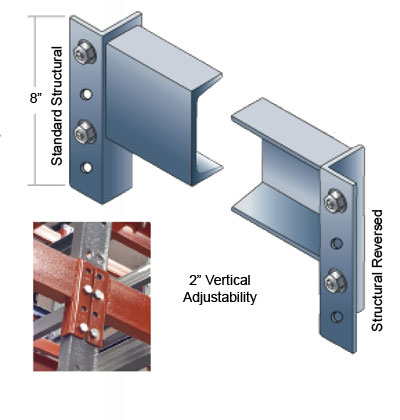
UNARCO rack designs conform to the latest Rack Manufacturers Institute (RMI) specifications and American Iron and Steel Institute (AISI) Cold Formed Steel Design Manual using “Load and Resistance Factor Design” (LRFD) Method.
| Beam Length | B-300 3″ Beam | B-350 3-1/2″ Beam | B-400 4″ Beam | B-450 4-1/2″ Beam | B-500 5" Beam | B-525 5-1/4″ Beam | B-525 5-1/4″ HD Beam | B-550 5-1/2″ Beam | B-600 6″ Beam | B-650 6-1/2″ Beam |
|---|---|---|---|---|---|---|---|---|---|---|
| 48″ | 7,671 | 9,243 | 10,763 | 12,452 | 14,283 | 15,254 | 17,222 | 18,368 | 20,779 | 23,339 |
| 54″ | 6,925 | 8,314 | 9,655 | 11,147 | 12,766 | 13,626 | 15,376 | 16,391 | 18,528 | 20,799 |
| 60″ | 6,327 | 7,569 | 8,766 | 10,103 | 11,551 | 12,323 | 13,898 | 14,808 | 16,727 | 18,766 |
| 66″ | 5,835 | 6,958 | 8,038 | 9,247 | 10,557 | 11,255 | 12,688 | 13,512 | 15,252 | 17,102 |
| 72″ | 5,085 | 6,448 | 7,430 | 8,533 | 9,727 | 10,365 | 11,678 | 12,431 | 14,022 | 15,715 |
| 78″ | 4,404 | 5,924 | 6,915 | 7,928 | 9,025 | 9,612 | 10,824 | 11,516 | 12,981 | 14,540 |
| 84″ | 3,857 | 5,171 | 6,473 | 7,409 | 8,422 | 8,965 | 10,091 | 10,731 | 12,088 | 13,533 |
| 90″ | 3,410 | 4,558 | 5,967 | 6,959 | 7,899 | 8,404 | 9,455 | 10,050 | 11,314 | 12,660 |
| 96″ | 3,040 | 4,052 | 5,292 | 6,564 | 7,441 | 7,913 | 8,898 | 9,454 | 10,636 | 11,895 |
| 102″ | 3,629 | 4,728 | 6,068 | 7,036 | 7,479 | 8,406 | 8,927 | 10,037 | 11,220 | |
| 108″ | 3,271 | 4,252 | 5,450 | 6,676 | 7,093 | 7,968 | 8,459 | 9,504 | 10,620 | |
| 114″ | 2,965 | 3,846 | 4,924 | 6,175 | 6,747 | 7,576 | 8,039 | 9,027 | 10,082 | |
| 120″ | 2,702 | 3,498 | 4,472 | 5,599 | 6,243 | 6,934 | 7,661 | 8,598 | 9,598 | |
| 126″ | 2,474 | 3,195 | 4,082 | 5,102 | 5,686 | 6,312 | 7,012 | 8,208 | 9,159 | |
| 132″ | 2,274 | 2,932 | 3,741 | 4,669 | 5,202 | 5,771 | 6,408 | 7,847 | 8,760 | |
| 138″ | 2,098 | 2,700 | 3,443 | 4,289 | 4,777 | 5,297 | 5,879 | 7,196 | 8,395 | |
| 144″ | 1,942 | 2,495 | 3,179 | 3,955 | 4,403 | 4,879 | 5,413 | 6,623 | 8,005 | |
| 150″ | 1,803 | 2,313 | 2,945 | 3,658 | 4,071 | 4,509 | 5,000 | 6,116 | 7,390 | |
| 156″ | 1,679 | 2,150 | 2,737 | 3,394 | 3,776 | 4,180 | 4,633 | 5,664 | 6,843 |
All capacities are expressed in pounds per pair of beams. Only gravity loading and the RMI required impact have been considered.
All values are based on a uniformly distributed load (i.e. each beam carries 50% of the load) and assume proper installation and no beam damage.
The deflection limit for all beams is the length divided by 180.
Roll-formed beams that are longer than 150” require lateral ties.
Values in the table are for the beam bending only.
Please consult Springfield, Engineering for any shelf load over 10,000 lbs.
Capacities include 12.5% impact for two pallets side by side. For a three-pallet-wide shelf, the values should be multiplied by 0.95. For one pallet per shelf, the values should be multiplied by 0.90.
Capacity chart is based on current RMI specifications.
UNARCO rack designs conform to the latest Rack Manufacturers Institute (RMI) specifications and American Iron and Steel Institute (AISI) Cold Formed Steel Design Manual using “Load and Resistance Factor Design” (LRFD) Method.
Upright Capacity Charts – Click to View
New ANSIMH16.1 – RMI Specification Regarding Frame Tables
| NO SIDE HOLES |

|

|
||||
|---|---|---|---|---|---|---|
| MAXIMUM UNSUPPORTED LENGTH | G0145 14 ga. | G0135 13 ga. | G0146 14 ga. | G0136 13 ga. | G0126 12 ga. | G0106 10 ga. |
| 36" | 17,028 | 21,626 | 23,323 | 32,722 | 42,237 | 52,184 |
| 42" | 15,197 | 19,298 | 21,268 | 29,470 | 37,695 | 46,515 |
| 48" | 13,234 | 16,736 | 19,030 | 26,028 | 32,983 | 40,667 |
| 54" | 11,823 | 14,889 | 17,339 | 23,480 | 29,540 | 36,374 |
| 60" | 10,650 | 13,347 | 15,902 | 21,347 | 26,684 | 32,792 |
| 66" | 9,467 | 11,806 | 14,423 | 19,190 | 23,830 | 29,220 |
| 72" | 8,295 | 10,295 | 12,927 | 17,035 | 21,007 | 25,685 |
| 78" | 7,289 | 9,014 | 11,485 | 15,020 | 18,425 | 22,519 |
| 84" | 6,441 | 7,941 | 10,249 | 13,315 | 16,263 | 19,869 |
| 90" | 5,723 | 7,038 | 9,186 | 11,866 | 14,440 | 17,636 |
| 96"* | 5,113 | 6,274 | 8,269 | 10,628 | 12,893 | 15,742 |
| WITH SIDE HOLES |
|
|
||||
|---|---|---|---|---|---|---|
| MAXIMUM UNSUPPORTED LENGTH | I0145 14 ga. | I0135 13 ga. | I0146 14 ga. | I0136 13 ga. | I0126 12 ga. | I0106 10 ga. |
| 36" | 15,676 | 20,049 | 21,776 | 31,759 | 39,659 | 49,723 |
| 42" | 14,003 | 17,891 | 19,891 | 28,551 | 35,452 | 44,322 |
| 48" | 12,205 | 15,515 | 17,829 | 25,117 | 31,073 | 38,749 |
| 54" | 10,910 | 13,803 | 16,266 | 22,684 | 27,865 | 34,659 |
| 60" | 9,833 | 12,374 | 14,934 | 20,602 | 25,196 | 31,245 |
| 66" | 8,746 | 10,945 | 13,561 | 18,501 | 22,524 | 27,842 |
| 72" | 7,667 | 9,544 | 12,168 | 16,405 | 19,874 | 24,474 |
| 78" | 6,740 | 8,357 | 10,824 | 14,450 | 17,450 | 21,458 |
| 84" | 5,958 | 7,362 | 9,668 | 12,799 | 15,414 | 18,932 |
| 90" | 5,296 | 6,525 | 8,673 | 11,398 | 13,695 | 16,804 |
| 96"* | 4,732 | 5,816 | 7,813 | 10,202 | 12,235 | 15,000 |
Unarco designs conform to the latest Rack Manufacturers Institute (RMI) specifications and American Iron & Steel Institute (AISI) Cold Formed Steel Design Manual using “Load and Resistance Factor Design” (LRFD) method. Frame capacities are based on maximum unsupported length which is the measurement of the distance between the floor and the top of the first beam or the maximum spacing between beams — whichever governs. Contact the Springfield Office for the following conditions:
- Any application where the frame load exceeds 31,000 pounds. These situations may need heavier than standard frame bracing.
- Any application that requires seismic design where the ground acceleration is greater than 0.05g or if Ss exceeds 25%g in IBC areas.
- Configurations that require a frame deeper than 60″ or taller than 480″.
- Applications that involve support of platforms or catwalks or any application other than standard pallet rack.
- Single bays of rack.
- Any condition which creates uncertainty as to the proper use of these tables. Table values are column capacities based on gravity loading only. The table values are based on the assumption that the rack bracing is adequate (none of the above conditions apply), and all other aspects of the rack have been properly designed. All values are for undamaged racks.
All values in these tables assume that each column carries half of the frame load and the table values are expressed in pounds per frame. These values are based on gravity loading only that is purely axial. Any condition where the axial load is accompanied by moment, the axial load capacity will be less. This will occur for non-symmetrical loading conditions. The capacities also assume the base plates and the bracing are of adequate strength and that all other parts of the rack have been properly designed. All values are for undamaged racks that are installed plumb. It is the rack user’s responsibility to properly maintain the racks to ensure that the carrying capacity of the racks is not reduced by damage and that changes to the rack configuration do not cause unsafe conditions.
| NO SIDE HOLES |

|

|

|
|||||||
|---|---|---|---|---|---|---|---|---|---|---|
| MAXIMUM UNSUPPORTED LENGTH | G0142 14 ga. | G0132 13 ga. | G0122 12 ga. | GO143 14 ga. | G0133 13 ga. | G0123 12 ga. | G0103 10 ga. | G0134 13 ga. | G0124 12 ga. | G0104 10 ga. |
| 36" | 25,435 | 33,520 | 39,821 | 30,843 | 41,096 | 51,476 | 63,741 | 50,706 | 64,855 | 84,401 |
| 42" | 23,444 | 30,676 | 36,396 | 28,793 | 38,120 | 47,526 | 58,756 | 48,621 | 61,985 | 80,444 |
| 48" | 21,325 | 27,694 | 32,809 | 26,574 | 34,942 | 46,644 | 53,487 | 46,310 | 58,825 | 76,108 |
| 54" | 19,142 | 24,662 | 29,170 | 24,243 | 31,646 | 39,047 | 48,085 | 43,809 | 55,430 | 71,476 |
| 60" | 16,952 | 21,665 | 25,577 | 21,854 | 28,316 | 34,747 | 42,690 | 41,157 | 51,859 | 66,632 |
| 66" | 14,809 | 18,775 | 22,119 | 19,464 | 25,030 | 30,543 | 37,428 | 38,396 | 48,169 | 61,659 |
| 72" | 12,739 | 16,016 | 18,824 | 17,124 | 21,855 | 26,519 | 32,407 | 35,566 | 44,419 | 56,637 |
| 78" | 10,911 | 13,647 | 16,040 | 14,849 | 18,814 | 22,711 | 27,694 | 32,708 | 40,664 | 51,641 |
| 84" | 9,448 | 11,767 | 13,830 | 12,906 | 16,271 | 19,582 | 23,879 | 29,862 | 36,955 | 46,740 |
| 90" | 8,258 | 10,251 | 12,048 | 11,316 | 14,209 | 17,058 | 20,801 | 27,065 | 33,339 | 41,992 |
| 96"* | 7,279 | 9,009 | 10,589 | 10,000 | 12,514 | 14,993 | 18,282 | 24,348 | 29,856 | 37,424 |
| WITH SIDE HOLES |
|
|
|
|||||||
|---|---|---|---|---|---|---|---|---|---|---|
| MAXIMUM UNSUPPORTED LENGTH | I0142 14 ga. | I0132 13 ga. | I0122 12 ga. | IO143 14 ga. | I0133 13 ga. | I0123 12 ga. | I0103 10 ga. | I0134 13 ga. | I0124 12 ga. | I0104 10 ga. |
| 36" | 24,178 | 31,597 | 37,812 | 29,265 | 40,818 | 49,410 | 61,149 | 47,030 | 60,569 | 78,558 |
| 42" | 22,285 | 28,936 | 34,560 | 27,656 | 37,770 | 45,619 | 56,367 | 46,556 | 59,923 | 77,738 |
| 48" | 20,271 | 26,140 | 31,154 | 25,525 | 34,531 | 41,604 | 51,313 | 44,362 | 56,868 | 73,548 |
| 54" | 18,196 | 23,295 | 27,698 | 23,286 | 31,191 | 37,480 | 46,130 | 41,986 | 53,586 | 69,072 |
| 60" | 16,114 | 20,479 | 24,287 | 20,991 | 27,834 | 33,352 | 40,954 | 39,464 | 50,133 | 64,391 |
| 66" | 14,077 | 17,758 | 21,003 | 18,696 | 24,538 | 29,317 | 35,906 | 36,835 | 46,566 | 59,585 |
| 72" | 12,109 | 15,159 | 17,875 | 16,448 | 21,371 | 25,455 | 31,089 | 34,138 | 42,041 | 54,732 |
| 78" | 10,372 | 12,924 | 15,230 | 14,263 | 18,352 | 21,799 | 26,568 | 31,412 | 39,301 | 49,904 |
| 84" | 8,981 | 11,149 | 13,132 | 12,396 | 15,840 | 18,796 | 22,908 | 28,694 | 35,726 | 45,167 |
| 90" | 7,850 | 9,715 | 11,440 | 10,869 | 13,809 | 16,374 | 19,956 | 26,019 | 32,230 | 40,579 |
| 96"* | 6,919 | 8,541 | 10,054 | 9,605 | 12,145 | 14,391 | 17,539 | 23,420 | 28,862 | 36,165 |
Unarco designs conform to the latest Rack Manufacturers Institute (RMI) specifications and American Iron & Steel Institute (AISI) Cold Formed Steel Design Manual using “Load and Resistance Factor Design” (LRFD) method. Frame capacities are based on maximum unsupported length which is the measurement of the distance between the floor and the top of the first beam or the maximum spacing between beams — whichever governs. Contact the Springfield Office for the following conditions:
- Any application where the frame load exceeds 31,000 pounds. These situations may need heavier than standard frame bracing.
- Any application that requires seismic design where the ground acceleration is greater than 0.05g or if Ss exceeds 25%g in IBC areas.
- Configurations that require a frame deeper than 60″ or taller than 480″.
- Applications that involve support of platforms or catwalks or any application other than standard pallet rack.
- Single bays of rack.
- Any condition which creates uncertainty as to the proper use of these tables. Table values are column capacities based on gravity loading only. The table values are based on the assumption that the rack bracing is adequate (none of the above conditions apply), and all other aspects of the rack have been properly designed. All values are for undamaged racks.
All values in these tables assume that each column carries half of the frame load and the table values are expressed in pounds per frame. These values are based on gravity loading only that is purely axial. Any condition where the axial load is accompanied by moment, the axial load capacity will be less. This will occur for non-symmetrical loading conditions. The capacities also assume the base plates and the bracing are of adequate strength and that all other parts of the rack have been properly designed. All values are for undamaged racks that are installed plumb. It is the rack user’s responsibility to properly maintain the racks to ensure that the carrying capacity of the racks is not reduced by damage and that changes to the rack configuration do not cause unsafe conditions.
| NO SIDE HOLES |
|
|
||||
|---|---|---|---|---|---|---|
| MAXIMUM UNSUPPORTED LENGTH | T0145 14 ga. | T0135 13 ga. | T0146 14 ga. | T0136 13 ga. | T0126 12 ga. | T0106 10 ga. |
| 36" | 17,902 | 22,751 | 25,618 | 34,383 | 43,637 | 43,637 |
| 42" | 15,977 | 20,302 | 23,246 | 30,916 | 38,945 | 48,080 |
| 48" | 13,913 | 17,607 | 20,691 | 27,257 | 34,076 | 42,035 |
| 54" | 12,429 | 15,664 | 18,779 | 24,559 | 30,520 | 37,598 |
| 60" | 11,196 | 14,042 | 17,165 | 22,304 | 27,569 | 33,895 |
| 66" | 9,953 | 12,421 | 15,518 | 20,029 | 24,619 | 30,203 |
| 72" | 8,721 | 10,831 | 13,860 | 17,761 | 21,700 | 26,549 |
| 78" | 7,663 | 9,483 | 12,275 | 15,644 | 19,035 | 23,277 |
| 84" | 6,771 | 8,354 | 10,922 | 13,856 | 16,802 | 20,537 |
| 90" | 6,017 | 7,405 | 9,765 | 12,339 | 14,918 | 18,229 |
| 96"* | 5,375 | 6,600 | 8,771 | 11,045 | 13,320 | 16,272 |
Unarco designs conform to the latest Rack Manufacturers Institute (RMI) specifications and American Iron & Steel Institute (AISI) Cold Formed Steel Design Manual using “Load and Resistance Factor Design” (LRFD) method. Frame capacities are based on maximum unsupported length which is the measurement of the distance between the floor and the top of the first beam or the maximum spacing between beams — whichever governs. Contact the Springfield Office for the following conditions:
- Any application where the frame load exceeds 31,000 pounds. These situations may need heavier than standard frame bracing.
- Any application that requires seismic design where the ground acceleration is greater than 0.05g or if Ss exceeds 25%g in IBC areas.
- Configurations that require a frame deeper than 60″ or taller than 480″.
- Applications that involve support of platforms or catwalks or any application other than standard pallet rack.
- Single bays of rack.
- Any condition which creates uncertainty as to the proper use of these tables. Table values are column capacities based on gravity loading only. The table values are based on the assumption that the rack bracing is adequate (none of the above conditions apply), and all other aspects of the rack have been properly designed. All values are for undamaged racks.
All values in these tables assume that each column carries half of the frame load and the table values are expressed in pounds per frame. These values are based on gravity loading only that is purely axial. Any condition where the axial load is accompanied by moment, the axial load capacity will be less. This will occur for non-symmetrical loading conditions. The capacities also assume the base plates and the bracing are of adequate strength and that all other parts of the rack have been properly designed. All values are for undamaged racks that are installed plumb. It is the rack user’s responsibility to properly maintain the racks to ensure that the carrying capacity of the racks is not reduced by damage and that changes to the rack configuration do not cause unsafe conditions.
| NO SIDE HOLES |
|
|
|
|||||||
|---|---|---|---|---|---|---|---|---|---|---|
| MAXIMUM UNSUPPORTED LENGTH | T0142 14 ga. | T0132 13 ga. | T0122 12 ga. | TO143 14 ga. | T0133 13 ga. | T0123 12 ga. | T0103 10 ga. | T0134 13 ga. | T0124 12 ga. | T0104 10 ga. |
| 36" | 26,564 | 34,714 | 41,254 | 32,023 | 43,716 | 52,950 | 65,590 | 51,903 | 66,396 | 86,429 |
| 42" | 24,468 | 31,769 | 37,706 | 29,876 | 40,452 | 48,887 | 60,461 | 49,769 | 63,459 | 82,377 |
| 48" | 22,242 | 28,680 | 33,990 | 27,556 | 36,983 | 44,585 | 55,039 | 47,403 | 60,224 | 77,937 |
| 54" | 19,950 | 25,541 | 30,219 | 25,121 | 33,406 | 40,165 | 49,480 | 44,843 | 56,748 | 73,194 |
| 60" | 17,655 | 22,437 | 26,498 | 22,631 | 29,811 | 35,742 | 43,928 | 42,129 | 53,092 | 68,233 |
| 66" | 15,412 | 19,443 | 22,915 | 20,142 | 26,281 | 31,417 | 38,514 | 39,302 | 49,314 | 63,141 |
| 72" | 13,249 | 16,587 | 19,502 | 17,709 | 22,889 | 27,279 | 33,347 | 36,405 | 45,475 | 57,998 |
| 78" | 11,342 | 14,133 | 16,617 | 15,346 | 19,656 | 23,361 | 28,497 | 33,480 | 41,631 | 52,882 |
| 84" | 9,816 | 12,186 | 14,328 | 13,330 | 16,965 | 20,143 | 24,572 | 30,567 | 37,834 | 47,863 |
| 90" | 8,576 | 10,616 | 12,481 | 11,683 | 14,790 | 17,547 | 21,405 | 27,703 | 34,132 | 43,001 |
| 96"* | 7,556 | 9,330 | 10,970 | 10,320 | 13,008 | 15,422 | 18,813 | 24,923 | 30,566 | 38,323 |
Unarco designs conform to the latest Rack Manufacturers Institute (RMI) specifications and American Iron & Steel Institute (AISI) Cold Formed Steel Design Manual using “Load and Resistance Factor Design” (LRFD) method. Frame capacities are based on maximum unsupported length which is the measurement of the distance between the floor and the top of the first beam or the maximum spacing between beams — whichever governs. Contact the Springfield Office for the following conditions:
- Any application where the frame load exceeds 31,000 pounds. These situations may need heavier than standard frame bracing.
- Any application that requires seismic design where the ground acceleration is greater than 0.05g or if Ss exceeds 25%g in IBC areas.
- Configurations that require a frame deeper than 60″ or taller than 480″.
- Applications that involve support of platforms or catwalks or any application other than standard pallet rack.
- Single bays of rack.
- Any condition which creates uncertainty as to the proper use of these tables. Table values are column capacities based on gravity loading only. The table values are based on the assumption that the rack bracing is adequate (none of the above conditions apply), and all other aspects of the rack have been properly designed. All values are for undamaged racks.
All values in these tables assume that each column carries half of the frame load and the table values are expressed in pounds per frame. These values are based on gravity loading only that is purely axial. Any condition where the axial load is accompanied by moment, the axial load capacity will be less. This will occur for non-symmetrical loading conditions. The capacities also assume the base plates and the bracing are of adequate strength and that all other parts of the rack have been properly designed. All values are for undamaged racks that are installed plumb. It is the rack user’s responsibility to properly maintain the racks to ensure that the carrying capacity of the racks is not reduced by damage and that changes to the rack configuration do not cause unsafe conditions.
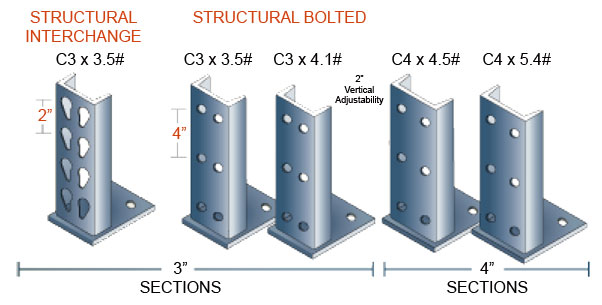
Structural Channel Frame Tables
Bolted
| Column Size | C3 x 3.5 | C3 x 4.1 | C4 x 4.5 | C4 x 5.4 |
|---|---|---|---|---|
| Shelf Space | 40″ Pan. | 40″ Pan. | 40″ Pan. | 40″ Pan. |
| 36″ | 27,515 | 29,821 | 44,172 | 47,134 |
| 42 | 27,515 | 29,821 | 44,172 | 47,134 |
| 48″ | 27,515 | 29,821 | 44,172 | 47,134 |
| 54″ | 27,515 | 29,821 | 44,172 | 47,134 |
| 60″ | 27,515 | 29,821 | 44,172 | 47,134 |
| 66″ | 27,515 | 29,821 | 44,172 | 47,134 |
| 72″ | 27,320 | 28,037 | 44,172 | 47,134 |
| 78 | 23,940 | 24,400 | 44,172 | 47,134 |
| 84″ | 20,724 | 21,033 | 44,126 | 46,257 |
| 90″ | 18,053 | 18,322 | 40,610 | 42,229 |
| 96″ | 15,867 | 16,103 | 37,162 | 38,328 |
Tear Drop
| Column Size | C3 x 3.5 |
|---|---|
| Shelf Space | 40″ Pan. |
| 36″ | 26,848 |
| 42 | 26,848 |
| 48″ | 26,848 |
| 54″ | 26,848 |
| 60″ | 26,848 |
| 66″ | 26,848 |
| 72″ | 26,657 |
| 78″ | 23,360 |
| 84″ | 20,222 |
| 90″ | 17,616 |
| 96″ | 15,483 |
All values in the above tables assume that each column carries half of the frame load. The table values are expressed in pounds per frame. These values are based on gravity loading only that is purely axial. Any condition where the axial load is accompanied by moment, the axial load capacity will be less. This will occur for non-symmetrical loading conditions. The capacities also assume that the base plates and the bracing are of adequate strength and that all other parts of the rack have been properly designed. All values are for undamaged racks that are installed plumb. It is the rack user’s responsibility to properly maintain the racks to ensure that the carrying capacity of the racks is not reduced by damage and that any changes to the rack configuration do not cause an unsafe condition.
Frame capacities are based on the unsupported length, which is the measurement of the distance between the floor and the top of the first beam or the maximum spacing between beams, whichever governs.
Capacities do not take seismic, wind or other lateral forces into consideration.
Upright frames have to be anchored with at least one anchor bolt in each post and require a minimum concrete floor strength of 3,000 PSI for the maximum loads.
Contact the Unarco Springfield Office for any of the following conditions:
Any application where the frame load exceeds 31,000 lbs. These frames may need larger base plates or heavier bracing.
Any application that requires seismic design where the design ground acceleration Ss exceeds 25%g in IBC areas.
Configurations that require a frame deeper than 60 inches or higher than 40 feet.
Applications that involve support platforms or catwalks or any application other than normal pallet rack.
Any single row where the height-to-depth ratio exceeds 6 to 1. These must be checked for anchorage against overturning.
Any condition which creates uncertainty as to the proper use of these tables.
Column protection is recommended for uprights subjected to potential column abuse from lift trucks.